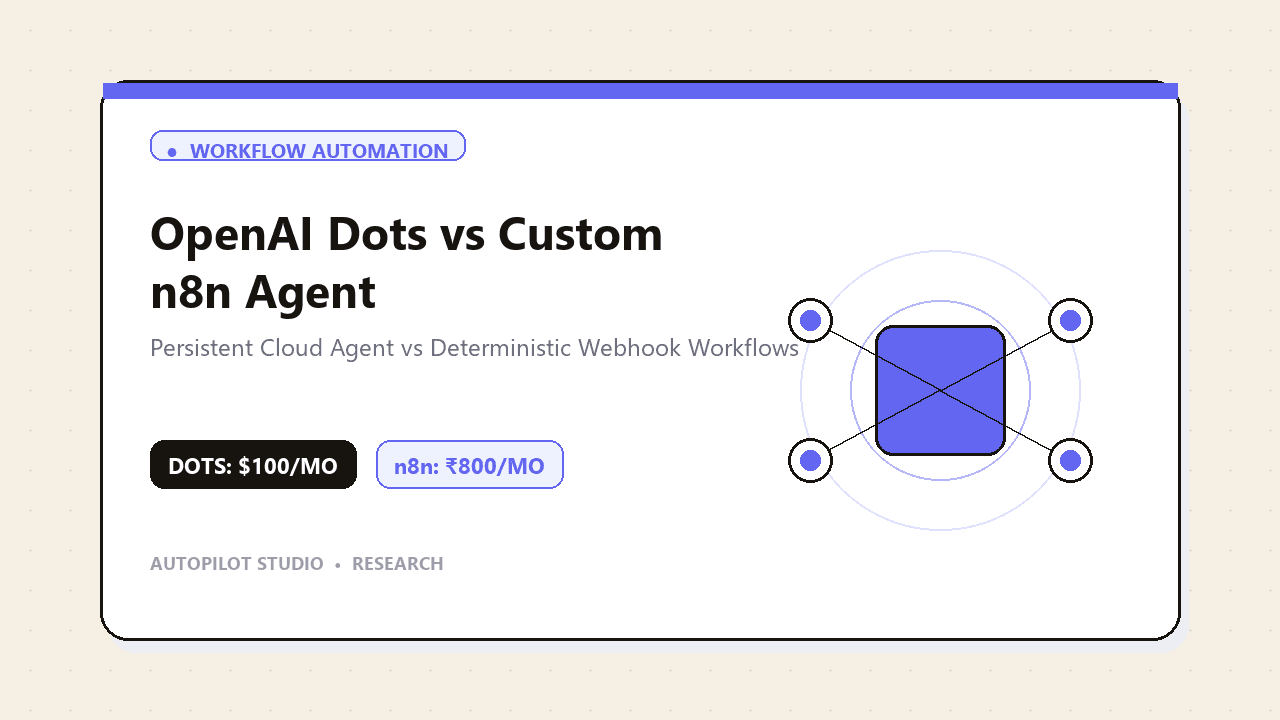
On September 29, 2026, OpenAI introduced Dots: always-on AI agents that run on their own virtual cloud computers and keep working after you close the tab. If you run a business, that sounds like the end of manual busywork, but at $100 a month per user on ChatGPT Pro, it is also a real addition to your software overhead. Below is what Dots actually do, how they differ from deterministic workflows built in tools like n8n, and how to decide which one fits your company.
The fundamental change is that standard chatbots stop the moment you close your browser. An always-on agent has its own persistent browser, cloud memory, and plugin connections, allowing it to complete multi-step tasks in the background.
Date OpenAI launched Dots always-on agents at DevDay 2026.
Starting price for ChatGPT Pro, which includes the first Dot.
Third-party applications connected through plugin integrations.
User governance controls: allow, approve, or block.
1. What an always-on agent is, and why Dots is not a chatbot
A traditional chatbot is reactive: you type a prompt, it generates text, and its job ends until you type again. A Dot is proactive and persistent, running on a dedicated virtual machine provisioned by OpenAI in the cloud.
Because each Dot has its own headless browser and environment, it can execute work while you sleep. For example, if you instruct it to monitor an inventory sheet, cross-reference supplier prices across three vendor portals, and prepare a morning purchase summary, it executes those web actions independently. It can be reached from ChatGPT, Slack, or Microsoft Teams, turning it into an asynchronous digital worker rather than a conversation window.
Source: TechCrunch: OpenAI Launches Dots Agentic Avatar
2. What Dots cost and who can get one
The first Dot is bundled into ChatGPT Pro and Business Premium subscriptions. For individual professionals, ChatGPT Pro starts at $100 per month (roughly ₹8,300 to ₹8,400 depending on exchange rates), while Business Premium pricing scales per seat with centralized administrative controls.
Availability is currently restricted by region and tier. Pro users in the European Economic Area (EEA), the United Kingdom, and Switzerland do not have access due to local regulatory review, while enterprise beta access must be enabled manually by workspace administrators. In India and the US, Pro subscribers have immediate access to their first agent.
Swipe through the numbers
- ChatGPT Pro$100/moincludes 1 Dot, individual use
- Business PremiumPer seatadmin governance, team sharing
- Custom n8n VPS₹800/mounlimited workflow runs on self-hosted VPS
Source: DEV: OpenAI Dots Limits and Real Cost Breakdown
3. How Dots decides what it may do: allow, approve, block
Giving an autonomous model access to your email, web browser, and workspace tools creates obvious operational risk. To mitigate this, OpenAI built a three-tier permission model into Dots: allow, approve, and block.
You configure these boundaries in the agent's management console:
- 01
Allow harmless routine read actions
Permit the Dot to read inbox summaries, check public websites, or pull read-only spreadsheets without pausing.
- 02
Require human approval for external actions
Force the agent to ping you on Slack or Teams before sending an email, submitting a form, or editing a CRM record.
- 03
Block destructive operations completely
Permanently restrict the agent from accessing bank portals, deleting database tables, or changing system passwords.
Saved credentials are kept in an isolated vault and are never exposed directly to the model's text context window, reducing the risk of prompt-injection leaks.
4. What to hand to a Dot, and what to keep
Dots excel at messy, open-ended research tasks where web layouts change frequently and deterministic code would break. They are effective for monitoring competitor pricing across scattered storefronts, collating weekly research digests, and summarizing incoming supplier PDFs.
However, Dots are inefficient for repetitive, high-volume transactions. If you process 500 customer leads per day, running every lead through an autonomous agent that navigates a browser burns unnecessary token compute and introduces latency. High-volume business logic belongs in deterministic automation pipelines, not probabilistic web browsers.
5. Dots vs a custom n8n agent: which one wins?
Choosing between an OpenAI Dot and a custom workflow in n8n comes down to whether your task requires open-ended browsing or deterministic reliability. Drag the slider below to compare their operational profile:
An n8n automation runs through strict API endpoints, executes in sub-second time, costs nothing in per-seat software licenses, and never misinterprets instructions. An OpenAI Dot handles fuzzy, visual tasks where no API exists, but costs significantly more at scale and requires supervision on critical actions.
Source: Autopilot Studio: The Solopreneur Tech Stack
6. 3 questions to ask before paying $100 a month
Before subscribing to ChatGPT Pro for your team to use Dots, answer these three practical questions:
- Does the task have an API? If your software tools connect via webhooks or REST APIs, an n8n or Make workflow will run faster, cost less, and never hallucinate.
- Can you afford an approval delay? If the agent requires human sign-off on every action to prevent errors, it will not save you time during high-volume periods.
- Does the workflow handle private customer data? Under data regulations like India's DPDP Act, sending raw customer information through a browser-based agent requires verified consent and audit logs.
If you need deterministic reliability, start with custom automation. If you need an ad-hoc assistant to research unstructured web pages in the background, a single Pro seat is worth testing.
Book a call with Autopilot Studio to evaluate your automation workflow.