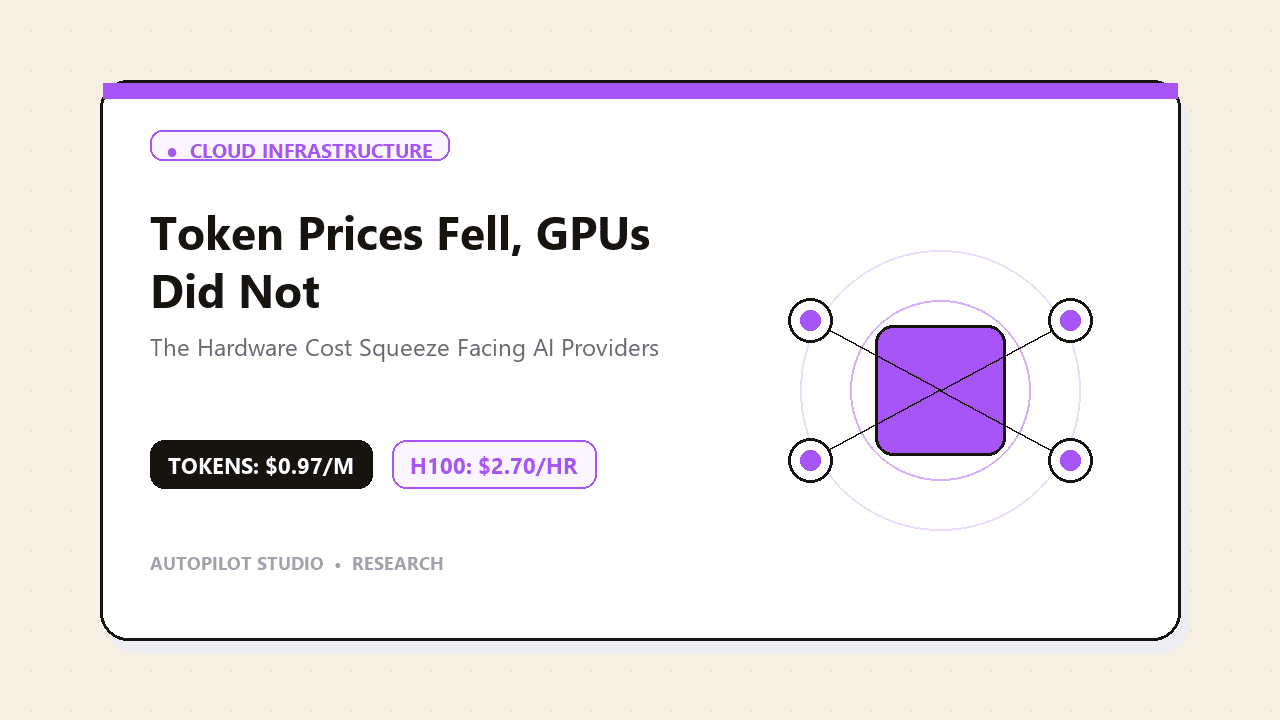
Every month, frontier AI labs announce lower API token prices. In 2026, input tokens on high-speed models dipped below $1 per million, representing a hundred-fold decline from earlier generations. Yet the physical hardware running those models—NVIDIA H100 servers, power grids, and liquid-cooled data centers—remains stubbornly expensive, with dedicated clusters renting between $2 and $7 per GPU-hour. Below is why this economic mismatch is squeezing your AI software vendors and how to protect your business automations before your tool provider changes terms.
When the cost of raw compute stays flat but customer token prices fall, SaaS startups that wrap AI models operate on razor-thin gross margins. If your software provider's margin collapses, they inevitably respond by throttling rate limits, introducing usage caps, or shutting down unexpected features overnight.
Record low cost per million tokens for entry-level frontier models.
Hourly rental cost per NVIDIA H100 GPU across cloud providers.
Typical gross margins for AI wrappers, down from 85%+ SaaS benchmarks.
Defensive steps to protect your workflows from vendor pricing shocks.
1. The token price war: How cheap AI actually got
Over the past four years, algorithmic breakthroughs, speculative decoding, and quantization dropped the cost of serving tokens by orders of magnitude. Today, routine tasks like text classification and summarization cost pennies per million tokens on models like GPT-6 Luna or Claude Haiku.
However, price cuts on raw tokens hide a secondary trend: the rise of autonomous agents. Because modern agents execute multiple reasoning cycles, call external tools, and parse broad context windows, businesses consume 10 to 20 times more tokens per finished task than they did in standard conversational chats.
Source: Silicon Data: Token Index & Infrastructure Tracking Analysis
2. Why hardware costs did not fall with token prices
While software developers enjoy cheap token prices, the physical infrastructure floor remains rigid. A single enterprise H100 GPU costs between $30,000 and $40,000 to purchase outright, while renting dedicated high-memory capacity on hyperscalers like AWS or Azure commands $7 to $12 per hour per GPU.
Even on specialized neo-cloud providers like Lambda or CoreWeave, on-demand instances rarely drop below $2 to $3 per GPU-hour. Furthermore, data centers face structural physical constraints: multi-megawatt power grid connections and liquid cooling retrofits cannot be downloaded or halved in cost through a software patch.
3. The margin squeeze: Why your AI wrapper SaaS is at risk
Traditional SaaS companies enjoyed 80% to 90% software gross margins: once the software was written, serving ten thousand users cost almost nothing in additional hosting.
AI wrapper products do not enjoy this privilege. Every time a customer uses an AI writing tool, code generator, or customer support bot, the vendor pays OpenAI or Anthropic a direct variable token cost. When token prices fall, vendors face pressure to slash their subscription prices, but because users increase usage volume, the vendor's underlying compute bill remains high.
When an AI startup discovers its gross margins have fallen to 40% while paying off venture-backed cloud commitments, they take predictable defensive actions:
- They quietly degrade background reasoning models to smaller, less accurate variants.
- They impose aggressive daily rate limits on "unlimited" plans.
- They introduce surprise per-task add-ons or pivot to enterprise retainers.
4. How to protect your automations from vendor volatility
Do not build mission-critical customer workflows on proprietary, single-feature AI wrappers. Follow these four defensive design rules:
- 01
Decouple your prompts from model providers
Store your system prompts in vendor-neutral Markdown or n8n templates rather than proprietary wrapper tool dashboards.
- 02
Test secondary backup models
Ensure your primary tasks have verified fallback endpoints on Anthropic or Google Gemini in case your primary provider experiences outages or rate limits.
- 03
Set hard API spend caps
Configure billing hard stops in your OpenAI and Anthropic dashboards to prevent runaway agent loops from draining corporate credit cards.
- 04
Own your workflow orchestration layer
Keep your business logic, CRM syncs, and database webhooks inside self-hosted n8n instances rather than third-party SaaS middleware.
If you control your orchestration pipelines and hold direct API keys with foundational model providers, you are immune to third-party SaaS shutdowns.
If your agency or enterprise relies on third-party AI tools and wants to audit your dependencies for resilience, our team can help you transition to stable, self-hosted architecture.
Book a workflow architecture consultation with Autopilot Studio.