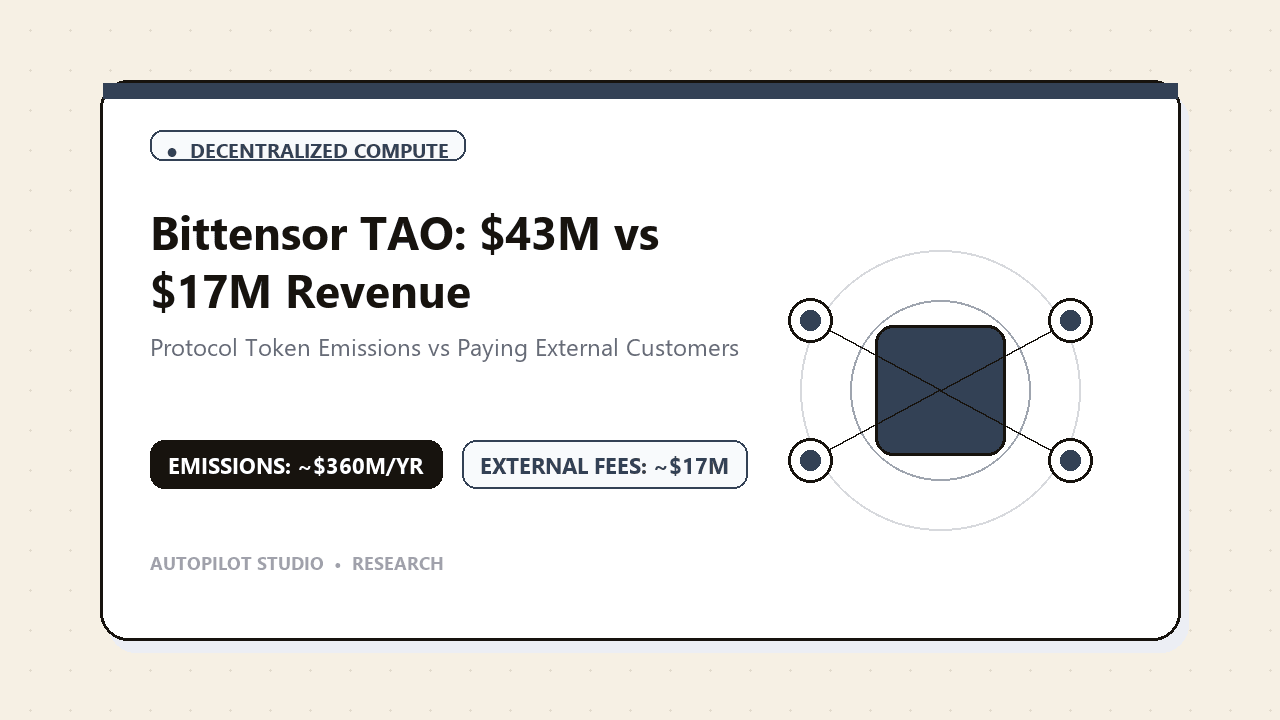
Advocates of decentralized artificial intelligence argue that peer-to-peer networks will break the monopoly of cloud giants like Microsoft, Amazon, and Google. At the center of this movement is Bittensor (TAO), a decentralized machine learning network that rewards model contributors with crypto tokens. In 2026, reports claimed Bittensor subnets generated upwards of $43 million in quarterly AI service revenue. Other institutional trackers, however, placed annualized figures closer to $17 million. Why do the numbers disagree by more than double, and does decentralized AI offer real utility to your business today?
Notice: This article provides general technological analysis and does not constitute financial, legal, or investment advice.
Discrepancy between community narrative and institutional revenue reports.
Core miner reward model funded by protocol token inflation.
Suitability for small business production workflows today.
1. What Bittensor and a subnet are, in plain words
To understand Bittensor without crypto jargon, imagine an open digital marketplace where machine learning models compete to answer specialized tasks:
- The Bittensor Network: Acts like an open coordinator that scores how well different independent algorithms perform.
- Subnets: Specialized sub-networks dedicated to distinct machine learning jobs, such as 3D asset generation, text inference, web scraping, or financial time-series forecasting.
- Miners and Validators: Miners run machine learning code and produce outputs; validators score the quality of those outputs and allocate daily network token rewards (emissions).
Instead of renting a server from Amazon Web Services, you theoretically query a Bittensor subnet to get cheaper, censorship-resistant AI inference.
2. The revenue figures, and why they disagree
Discrepancies in Bittensor's commercial metrics stem from how analysts calculate "revenue" in a protocol economy:
- The $43M quarterly narrative: Bullish industry commentary and community reports pointed to $43 million in Q1 2026 subnet activity, extrapolating over $170 million in annualized velocity. This calculation often bundles internal validator token staking, registration fees, and network-subsidized compute value together as customer demand.
- The $17M institutional estimate: Institutional research platforms, such as Artemis and FalconX, distinguish between internal token churn and verified external customer payments. When counting real businesses spending fiat currency or stablecoins to purchase AI inference off the network, annualized revenue figures drop to roughly $17 million.
| Metric Dimension | Community Narrative ($43M) | Institutional Tracking ($17M) |
|---|---|---|
| Calculation basis | Aggregated subnet compute valuation | Verified external customer fee payments |
| Token emissions | Counted as protocol productivity | Treated as inflationary miner subsidies |
| Enterprise adoption | Assumes rapid market rotation | Tracks signed off-chain commercial deals |
| Auditability | Difficult to isolate on-chain | Monitored via third-party analytics |
3. Where the money comes from: payments vs emissions
The economic foundation of Bittensor still relies heavily on protocol inflation rather than paying enterprise clients.
The network distributes an estimated $360 million annually in minted TAO tokens to miners and validators to incentivize infrastructure deployment. While this mechanism successfully attracts thousands of high-end GPUs to the network, true commercial sustainability requires paying customers whose fees exceed the cost of token emissions.
Subnets like Chutes (inference) and Targon (evaluation) are actively building commercial gateways to convert enterprise billing into subnet compute, but the transition from token-incentivized sandbox to profitable cloud provider is ongoing.
4. The institutional side: Grayscale's trust, Yuma's fund and Covenant's exit
Institutional capital has shown cautious curiosity alongside notable friction:
- Institutional funds: Grayscale launched its dedicated Bittensor Trust, offering accredited investors exposure to TAO, while venture vehicles like the Yuma fund committed capital to back promising subnets.
- Ecosystem friction: Subnet dynamics remain fiercely competitive. Major players like Covenant announced exits from specific subnets in early 2026 due to governance disputes and validator voting concentration, demonstrating the operational volatility of decentralized consensus.
5. Does it matter to your business?
If you are a small or mid-sized business building customer-facing AI agents, you should almost certainly stick with traditional cloud APIs (OpenAI, Anthropic, AWS Bedrock, or specialized open-source hosts like RunPod) today.
Decentralized compute introduces substantial operational friction:
- Billing complexity: Paying via cryptocurrency wallets requires specialized accounting and introduces token price volatility.
- Variable latency: Queries routed across decentralized miners lack the guaranteed Service Level Agreements (SLAs) required for real-time customer chatbots.
- Debugging hurdles: Tracing dropped connections across a decentralized validator pool is significantly harder than calling a standard REST API.
While decentralized AI is an intriguing long-term hedge against cloud monopolies, practical business operations in 2026 run best on stable, deterministic infrastructure.