Let’s be honest: AI lies.
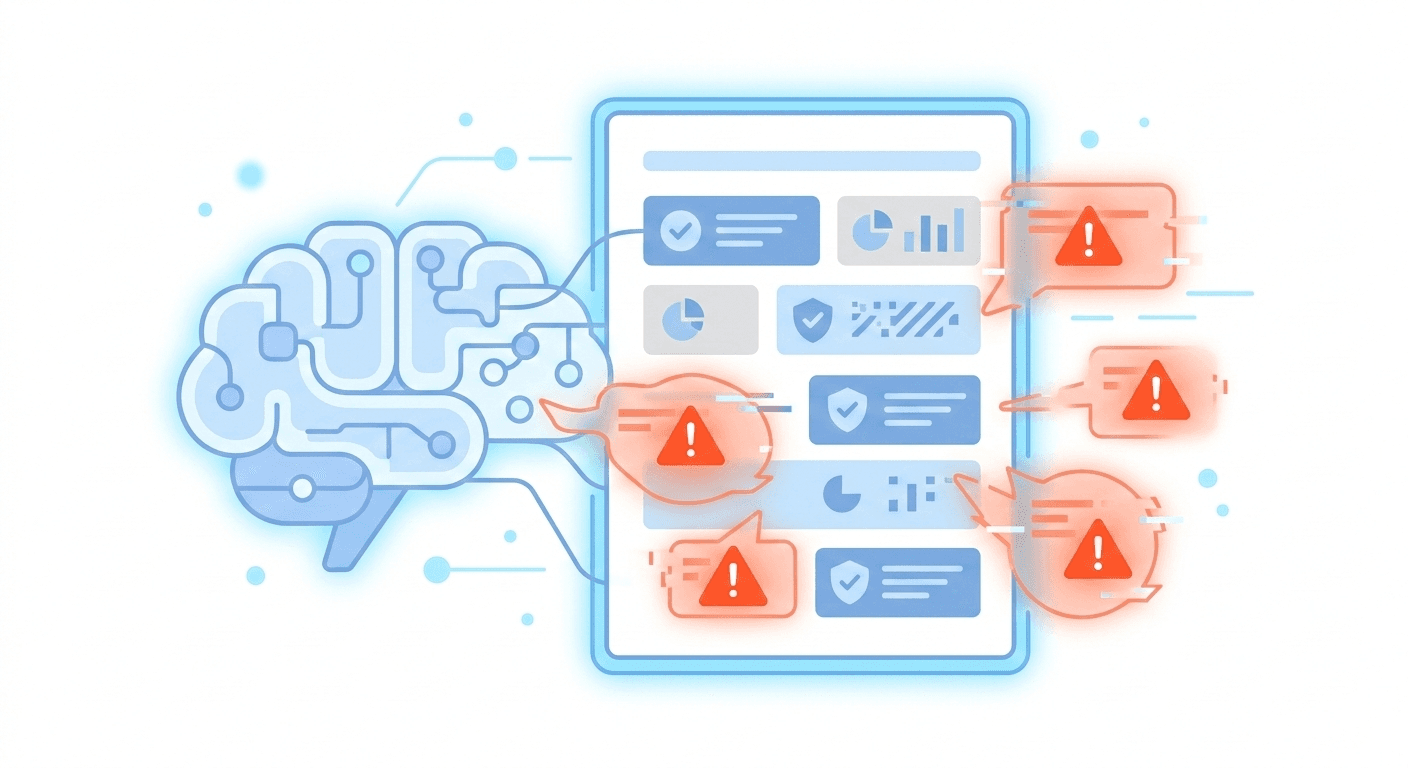
It invents court cases, fabricates URLs, and does math with the confidence of a genius while being completely wrong. In the industry, we call these hallucinations. But if you want to use AI for your business, "hallucination" isn't just a quirky tech term - it’s a liability.
Here is the truth about why AI lies and the specific frameworks we use at Autopilot Studio to ensure our systems are "guilty until proven innocent."
1. Why AI "Lies" (The Probabilistic Truth)
AI doesn't "know" facts the way a human does. It is not a database; it is a prediction engine.
- Statistical Relationships: When an LLM says "The capital of France is Paris," it isn't looking up a map. It is predicting that "Paris" is the most statistically likely word to follow that sequence based on its training.
- The Creativity Trade-off: The same mechanism that allows an AI to write a creative poem is the one that causes it to invent a fake statistic. High "Temperature" settings increase creativity but also increase the risk of a hallucination.
- Compression Gaps: An LLM is a "zipped file" of the internet. If the training data is thin on a specific niche topic, the AI will fill in the gaps with the most "plausible-sounding" nonsense.
Source: DataCamp: AI Hallucinations Guide
2. The Autopilot Validation Framework
We don't trust the first answer an AI gives us. Neither should you. Here is the Fact Check List Pattern we implement to force the model to audit its own logic.
The 3-Step Audit Loop:
- Generate: Ask the model to provide the initial answer.
- Audit: In a follow-up prompt, command the AI: "Audit your previous answer. List every claim of fact. Verify if this claim is supported by your internal certainty. If uncertain, flag it."
- Refine: Ask the model to regenerate the final answer based only on the verified facts.
By forcing the model to traverse its own logic path twice (a technique called Chain of Thought), you catch the majority of statistical outliers - aka the "lies."
3. The Enterprise Solution: RAG
For businesses where the cost of error is high (Legal, Finance, Medical), we don't rely on the AI's "memory" at all. We use Retrieval-Augmented Generation (RAG).
Think of RAG as a "Reference Desk." Instead of letting the AI guess, we force it to look at a specific, trusted document (like your company handbook) and state: "Using only the provided text, answer the following..." If it can't find the answer in your data, it is programmed to say "I don't know" rather than guessing.
Source: Stanford: Assessing the Reliability of Legal RAG Tools
4. Your Manual Verification Checklist
Before you hit "send" on any AI-generated content, run this 3-point check:
| Check | Action |
|---|---|
| Source Reality | Click the links. Studies show up to 30% of AI-generated URLs are fabricated. |
| Logical Consistency | AI is notoriously bad at math. Re-calculate any numbers manually. |
| Bias Check | If the tone feels overly persuasive or opinionated, it’s reflecting training data, not facts. |
The Verdict: Trust but Verify
In 2026, the ability to generate content is infinite and free. The ability to verify and architect that content is the scarcity. We are entering the age of the AI Architect - the person who ensures the engine stays on the road.
Don't let hallucinations ruin your reputation.
Building trust with AI requires more than just good prompts; it requires a validation infrastructure.
Book a call to build validated AI systems with us.
Research provided by The State of AI in 2026 Analysis.