
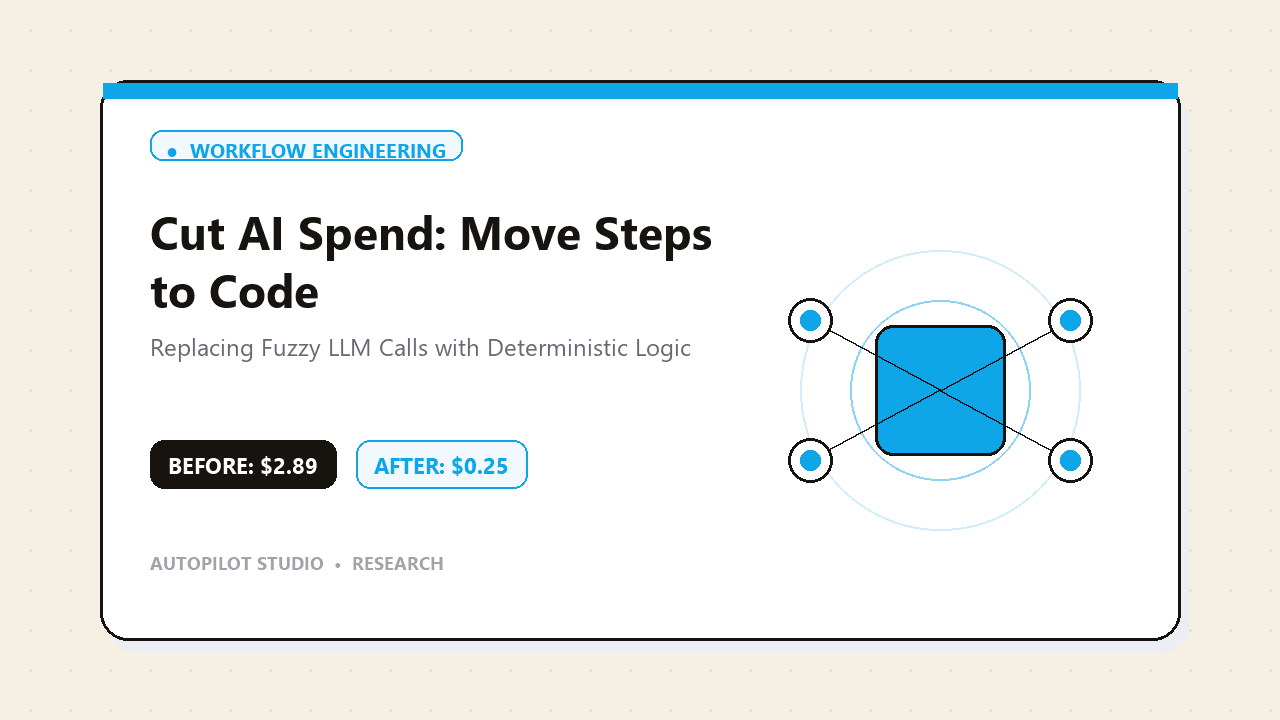
If your business runs autonomous AI workflows, you have likely noticed that monthly token bills scale faster than your transaction volume. In recent compliance testing, AI workflow startup Grep reported that moving repetitive reasoning steps out of frontier LLMs and into deterministic code cut operational costs from roughly $2.89 per alert down to $0.25—a 91% drop. Below is how this architecture, known in research as "Progressive Crystallization," works in practice and how you can apply it to your n8n workflows.
When founders build their first AI automation, they often route every step through an LLM: extracting an email address, formatting dates, checking if a lead is qualified, and writing database rows. Calling a model for work that a regular expression or five lines of JavaScript can do burns tokens, adds three seconds of latency, and introduces unnecessary failure points.
Cost reduction reported by Grep after moving repetitive steps to code.
Reported drop in model cost per compliance alert in initial testing.
Token consumption of deterministic JavaScript or regex nodes.
Execution speed of local code compared to multi-second model calls.
1. The 91% cost reduction claim: How solid is the math?
The benchmark published by AJ Asver, co-founder of compliance automation engine Grep, compared two architectures across a 100-alert test suite:
In the first setup, an open-ended agent received raw documents and dynamically decided every action using frontier reasoning loops. Across 100,000 alerts, that architecture extrapolates to over $289,000 in token consumption. In the second setup—using their AgentRun harness—the system analyzed agent execution traces, extracted the repeated rule-based branches, and replaced them with structured Python code, reserving the LLM only for novel edge cases.
While the 91% saving represents a vendor's internal test, the underlying computer science principle—termed Progressive Crystallization in academic literature (arXiv:2607.07052)—is universally true: stochastic models are great for discovery, but terrible for running static pipelines.
Source: AJ Asver on X: Grep AgentRun Cost Optimization Breakdown
2. Why full LLM pipelines waste your money
When you ask an LLM to perform basic data extraction, you pay three distinct penalties:
- Context Window Tax: You send 2,000 tokens of system instructions and customer history just to extract an 8-digit order number.
- Speed Latency: Waiting for a model to generate text takes between 1.5 and 4 seconds per node. A workflow with four chained LLM calls takes over 10 seconds to finish.
- Probabilistic Fragility: A model might format a date as
YYYY-MM-DD99 times, and outputDD/MM/YYYYon the 100th run, crashing your downstream database connectors.
Plain code executes in under 5 milliseconds, costs ₹0 in API fees, and delivers 100% deterministic output every single time.
3. The 4-step framework to crystallize your workflows
To trim 70% to 90% off your own API expenses in n8n or Make, follow this progressive optimization sequence:
- 01
Trace and log every agent step
Run your workflow for 100 real requests and record which decisions were identical across 90% of executions.
- 02
Extract deterministic rules into code
Replace LLM nodes handling regex extraction, JSON restructuring, and status routing with native JavaScript Code nodes.
- 03
Use small models for classification
If you only need to classify intent (e.g. 'Billing' vs 'Sales'), route to GPT-4o-mini or Claude Haiku rather than flagship reasoning models.
- 04
Reserve frontier models for anomalies
Configure an IF-node branch so that high-confidence requests pass through code, and only complex edge cases invoke frontier models.
4. A real-world example in n8n: Inbound lead qualification
Consider an inbound lead intake automation:
- The Wasteful Way: Inbound email arrives $\rightarrow$ LLM extracts name and phone $\rightarrow$ LLM checks if budget exceeds ₹50,000 $\rightarrow$ LLM drafts confirmation email $\rightarrow$ LLM generates CRM JSON payload. Cost: ~4,500 tokens per lead.
- The Crystallized Way: Inbound email arrives $\rightarrow$ JavaScript node extracts fields via regex $\rightarrow$ Code node checks
budget >= 50000$\rightarrow$ LLM generates personalized email draft $\rightarrow$ Code node inserts row into HubSpot. Cost: ~600 tokens per lead.
You preserve the creative personalization where human language matters, while eliminating 85% of the token overhead on administrative plumbing.
If your company's monthly OpenAI or Anthropic API bills are escalating, our engineering team can audit your pipelines and convert bloated agent loops into hardened, high-speed code.