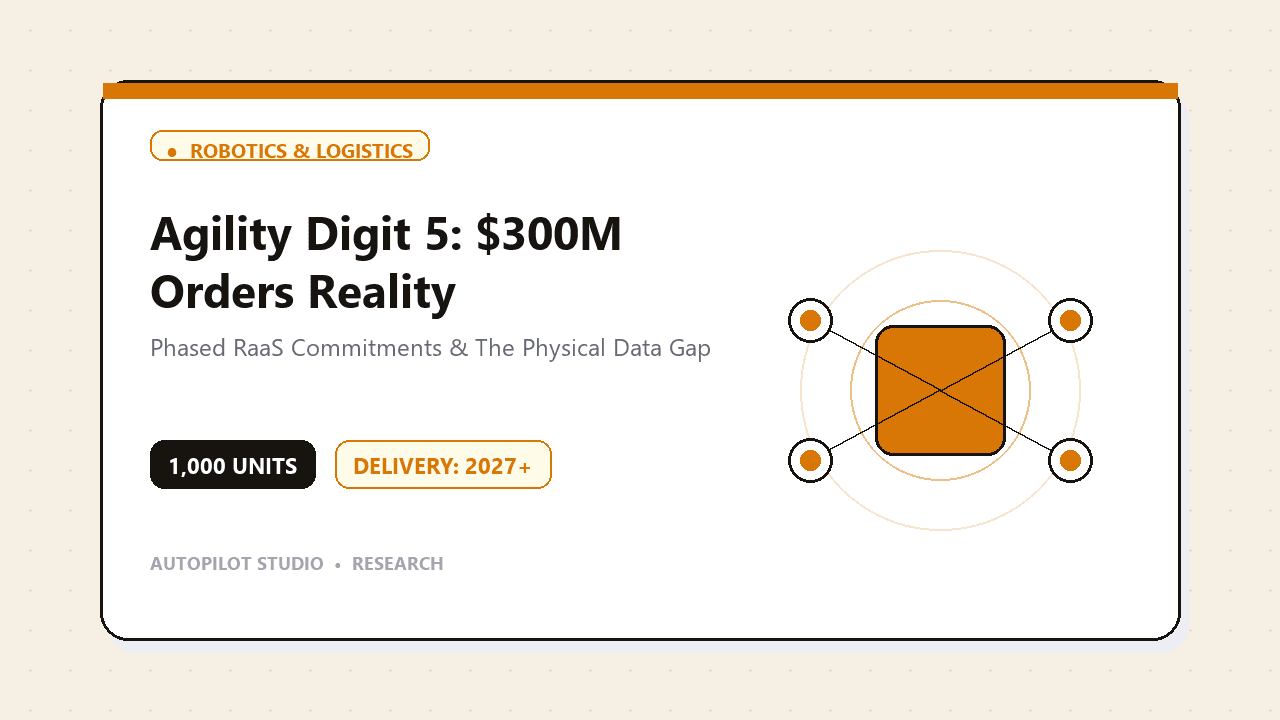
When Agility Robotics unveiled its next-generation humanoid robot, Digit 5, in September 2026, the company highlighted an eye-catching commercial milestone: more than $300 million in multi-year orders. Viral tech commentary declared that humanoid factory workers have finally arrived in volume. But a close reading of commercial filings shows that thousands of robots are not shipping to warehouses this month. The headline covers multi-year commitments contingent on future milestones. Behind the hardware lies a deeper bottleneck: robotics still lacks the internet-scale training data that makes software AI work.
Multi-year booked commitments across phased delivery tranches.
Robot units under the primary customer agreement structured as RaaS.
Commercial delivery ramp timeline before broad general availability.
1. What Agility announced
Agility Robotics revealed Digit 5 with significant upgrades over earlier iterations, emphasizing cooperatively safe operation alongside human warehouse staff without physical security cages. Alongside the reveal, Agility publicized a cumulative commercial backlog exceeding $300 million.
The announcement was timed alongside capital expansion discussions and a planned public listing via a merger with Churchill Capital Corp XI, drawing widespread venture and logistics interest.
2. What the $300M really is
The $300 million figure is not realized revenue in Agility's bank account today.
Instead, regulatory filings clarify that the backlog primarily consists of a multi-year Robots-as-a-Service (RaaS) framework agreement with a major customer covering approximately 1,000 humanoid units. Under RaaS agreements:
- Units are released in phased operational tranches rather than delivered all at once.
- Revenue recognition depends on robots meeting strict site-level throughput and uptime benchmarks.
- Commercial customer delivery ramps begin in late 2027, with full deployment extending across several years.
Digit 5 is a major hardware milestone, but claims that thousands of autonomous humanoids are actively packing boxes today misrepresent commercial reality.
3. Why robots lack data: there is no internet of physical work
Software models like ChatGPT or Claude progressed rapidly because they trained on trillions of tokens from the open internet—books, articles, GitHub repositories, and forum discussions created over three decades.
Physical robotics has no equivalent dataset. There is no web repository of physical friction, torque, balance corrections, or delicate hand grasping.
While language models consume petabytes of free public text, humanoid robotics labs possess only a few hundred thousand hours of physical teleoperation data. Training an end-to-end foundation model for physical manipulation requires tens of millions of hours of real-world physics interaction.
| Infrastructure Dimension | Language Models (LLMs) | Humanoid Robotics |
|---|---|---|
| Training corpus | Trillions of public internet tokens | Sparse physical teleoperation logs |
| Data collection cost | Web crawling at fractions of a cent | Expensive hardware rigs and human pilots |
| Failure penalty | Hallucinated sentence in chat | Damaged physical equipment or human injury |
| Deployment timeline | Available instantly via API | Requires physical hardware supply chains |
4. What world models can and cannot do about the data gap
To bypass the physical data shortage, robotics researchers use synthetic world models and physics simulators. For instance, models like the Beijing Academy of AI's Orca train on over 125,000 hours of video to predict physical object dynamics.
World models are powerful data multipliers, but they do not create physical ground truth out of thin air:
- What they do well: They allow robots to simulate balance, rough navigation, and basic pathfinding millions of times faster than real-time inside GPU clusters.
- Where they break: Simulators struggle with edge cases in tactile contact, such as gripping slippery packaging, adjusting to dented metal boxes, or feeling subtle weight distribution shifts.
Until physical tactile telemetry scales by an order of magnitude, humanoid dexterity will remain confined to controlled pilot testbeds.
5. What it means for a small business: not yet, so start with software
If you run a manufacturing plant, an e-commerce brand, or a regional fulfillment hub, you will not be leasing humanoid robots to replace warehouse shifts in 2026. Hardware units remain expensive, maintenance requires dedicated engineers, and software pilots are tightly allocated to enterprise supply chain giants.
The good news is that you do not need physical robots to dramatically reduce operational overhead.
The vast majority of small-business waste happens in software: manual data entry between spreadsheets, lost supplier invoices, delayed WhatsApp customer replies, and unrouted support tickets. Automating your digital workflows in n8n or Python costs a tiny fraction of a robot lease and delivers immediate operational ROI today.